Neurofeedback at TheraThrive
Now is the time to thrive
19-Channel Brain Mapping and Neurofeedback Therapy
We offer both 19-channel brain mapping and neurofeedback training therapy in order to best holistically support you (or your child).
In overview, 19-channel brainmapping provides quantitative information about your specific brain activity. Neurofeedback training is an empirically supported therapy that directly teaches your brain to up or down regulate.
In specific, brain mapping, also known as Quantitative Electroencephalogram (QEEG), is a way for you to see details about your specific brain activity. This is helpful because your brain activity is directly linked to your symptoms, experiences, and performance. A brain map shows a picture of what the electrical activity in your brain looks like and how it may affect you.
Neurofeedback therapy (also called brain training, EEG biofeedback, neurobiofeedback, and neurotherapy) focuses on symptom management or performance improvement. Brain training essentially assists your brain to rewire its own electrical activity. Neurofeedback therapy is proven to support people who may experience symptoms of ADHD, OCD, anxiety, depression, insomnia, trauma, postpartum hardship, and more.
Why 19 channels?
19-channel brain mapping and neurofeedback therapy specifically provides a comprehensive map of your brain and an in-depth brain training. This is because it uses 19 electrodes to measure your brain activity across multiple areas and in real time. While some neurofeedback systems may be limited to 4 channels or even fewer, our equipment allows for 19-channels, which is considered to be the best and most comprehensive.
With both 19-channel QEEG-brain mapping and neurofeedback therapy (brain training), we discover specific aspects of your brain functioning, identify how to best manage your symptoms, and coach your brain to rewire its activity to best support you!
19-Channel QEEG Brain map
Neurofeedback is very personalized and unique for you. When you begin neurofeedback therapy, we first concentrate on understanding your brain’s communication between different neurological regions.
For example, when electrical activity is moves in certain areas of your brain more slowly or quickly, this can impact symptoms. Your experiences of those symptoms can differ vastly depending upon the frequency and speed of brainwaves in various locations.
A Quantitative Electroencephalography, or QEEG brain map, is an objective assessment measure that evaluates electrical activity (brainwaves) in your brain. With 19-channel brain mapping, we are able to see neurological activity in the frontal, central, parietal, and occipital areas of your brain in real time.
A brain map provides a live 3D visual representation of your brain, and the activity occurring in it, so that we can assess how to best train your brain to alleviate your symptoms and/or improve your performance.
At TheraThrive, licensed counselors assess you and analyze your QEEG brain map in order to create a personalized treatment plan for neurofeedback therapy. Since our brain maps capture more data and information, your treatment options are more specialized. Having the full 19-channels for mapping allows us to create a truly personalized training program for your brain, to achieve the outcomes you desire.
19-Channel Neurofeedback Therapy
Neurofeedback therapy (brain training) can be conducted in many different ways, and at TheraThrive we strive to offer our clients the very best. Although neurofeedback options include 1 to 4 channel training, we offer the full 19-channel training, which allows access to view 19 different aspects of the brain in real time.
19-channel neurofeedback training provides 3D images of your entire brain, allowing our neurofeedback techs and counselors to more deeply understand how your brain functions and how various areas of your brain interact.
When you receive neurofeedback therapy, your brain is trained to regulate and be in balance for improvement of your unique symptoms and needs.
Neurofeedback brain training can help with many symptoms and experiences, including yet not limited to:
- Impulse, attention, and regulation symptoms relating to ADHD
- Traumatic Brain Injury
- Anxiety
- Emotional regulation and getting stuck in a loop (relating to autism)
- Obsessive Compulsive
- Chronic Pain
- Depression
- Disordered Eating
- Learning Disabilities or Differences
- Migraines
- Post Traumatic Stress
- Sleep Disorders and Insomnia
- PANS/PANDAS
- Tourette Syndrome
Types of Neurofeedback Therapy Training
Three types of Neurofeedback training that we implement at TheraThrive are described below. Your neurofeedback counselor will support you by recommending a personalized protocol for you. Your personalized protocol will be informed by your history, your presenting symptoms and needs, and/or your QEEG Brain Map data. At times, multiple trainings can be implemented simultaneously.
SLORETA training
SLORETA training, or sometimes called Sparse LORETA, is a brain training based off of an algorithm that approximates the location of specific brain activity based on the QEEG signals from your Brain Map.
This training provides a 3D image of the brain activity so you can see which regions of the brain have more and less activity (or too much or too little activity). The specialized algorithm utilized supports with training deeper areas of the brain, with greater accuracy and speed, when compared to traditional neurofeedback training.
Z-SCORE training
The strength of Z-SCORE training is that it works to regulate brain activity towards a more balanced state.
This balanced state is based off of normative data, where deviations are identified and then utilized to guide training protocols.
In Z-SCORE training, we are actively working to move brainwave patterns towards a more typical range, because a balanced state enhances overall well being.
This method relies on a large database of brainwave activity collected from people of similar demographics as you.
Sensorimotor-Rhythm Training (SMR)
Sensorimotor-rhythm (SMR) training involves training your brain to enhance your SMR brainwave frequency to a specific level in order to increase concentration, sustained attention, and overall cognitive performance.
This training has many fuctions. For example, SMR training can specifically help reduce sleep difficulties and anxiety. Some people report improvements in motor skills after SMR training.
Additionally, SMR training is often also called Focus training because it can help people to gain peak performance, and thus SMR training also benefits athletes, dancers, exam or test-takers, and other peformers.
SMR training is also beneficial for ADHD focus needs, insomnia, anxiety, and overall improvement in cognitive functioning, including support with sustaining memories and attention.
What Your Neurofeedback Sessions May Look Like
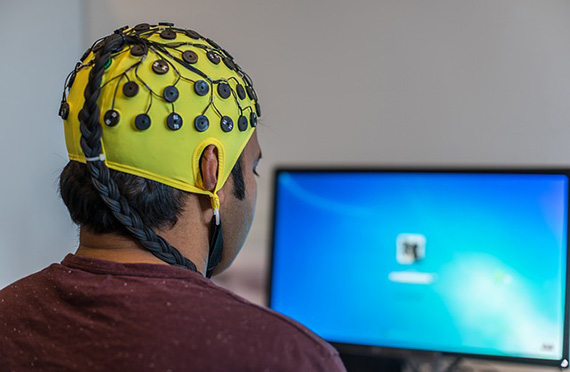
- For both neurofeedback brainmapping and neurofeedback therapy (brain training), a 19 Channel neurofeedback cap will be placed on your head, with two attachments on the earlobes as well.
- This cap includes a small sites for electronic measurement, and in each of these sites, we will place a small amount of conductive gel in order to get an accurate read of brain activity. The gel can feel cool and wet to the touch. Your hair may look wet in spots after the cap is removed, and the gel can dry out. Additionally, your head may show slight indentations where the elastic portion of the cap was placed on your head. The cap and gelling should never hurt.
- During brainmapping we will map your brainwaves when your eyes are open and also when your eyes are closed. To capture your eyes-open data, you will be asked to continuously look at (or stare at) a simple object for six to ten minutes while we record your brain activity. During this time you will be asked to endeaver to remain as still as you are able, so we can record clear and accurate data. To capture your eyes-closed data, you will also be asked to sit with your eyes closed for up to ten minutes while we record activity again. We will likely ask children to sit still for less time than adults, however we aim to capture at minimum of 6 minutes of brain activity. If you (or your child) is not able to sit still for at least 6 minutes, please talk with us about it. We can provide support through this process, and we may develop a gentle neurofeedback protocol to start with, such as SMR. Your brain map is important because it provides a baseline of your brain’s functioning. After that first session, brain mapping may occur again from time to time throughout treatment, such as when a new baseline is necessary or to ensure progress is being made.
- During neurofeedback therapy (brain training) you will be prompted to engage in a visual activity of your choice for up to 20 minutes. This could include watching a Youtube video that you enjoy, watching another type of show, or playing a visual game). If you choose to watch a video or other show, typically your visual image of the show will improve (being bright and clear) or diminish (darken) based on your brain activity, with improvements to what you see occurring when your neural activity matches a goal. For example, if the goal is a reduction in activity in a certain region, then the visual may become less dim when your brain acvity in that particular region is reduced. In addition to visual cues and guides, there will also be reinforcing sounds that are paired with positive changes in your brain. The auditory factor is typically pleasing to the brain in order to positively reinforce the activity and give you an external indication of improvement as well. Your brain will do this all of this work without your effort. Your effort will be pretty relaxing– just watching the video clearly or playing and winning the game. People report that brain training is often relaxing, enjoyable, and fun!
The Neurofeedback Journey
1. Assessment Meeting
- Meet with one of our Licensed Clinicians to discuss your needs, presenting concerns, and goals for neurofeedback
- At your first meeting we will assess your main needs and concerns. We will also explore your baseline as a tool to use later for monitoring progress made
- During our initial assessment, we will decide if you will start with SMR training to improve focus and reduce anxiety, or if we can begin with brain mapping. Most older children and adults can begin with brain mapping. Younger children will typically start with SMR training, as a means to introduce the equipment in an enjoyable manner and build up tolerance to wearing a neurofeedback cap and sitting fairly still (so that brain mapping can occur later)
- As time permits, you will likely complete a brain map (or start with SMR training) at your first session
2. Brain Map Results
- If you completed a brain map, our Neurofeedback Team will review your results and determine a protocol plan
- Our Licensed Clinician will provide you with a report that summarizes your brain mapping results
- We will discuss these results with you and solidify next steps
3. Neurofeedback therapy/training
- You next schedule with our neurofeedback tech for brain training according to the protocol plan established by your Licensed Clinician. Brain training typically occurs 2-3 times per week, and continues for several weeks
- Depending upon your needs, we may recommended talk therapy (or play therapy for children) with one of our therapists, to further support your well-being and meet your goals.
4. Update your brain map
- After several weeks of brain training, you may do another brain map, in order to view and ensure progress is being made
5. Final feedback
- Meet again with your Licensed Clinician for a feedback session, to review and discuss your second brain map results, to discuss your progress and changes, and to either complete the neurofeedback process or discuss next steps
6. And beyond…
- If it would be beneficial, continue with additional brain training protocols or less frequent neurofeedback for maintenance (maintenance does not often continue long-term).
Find A Therapist
Documents